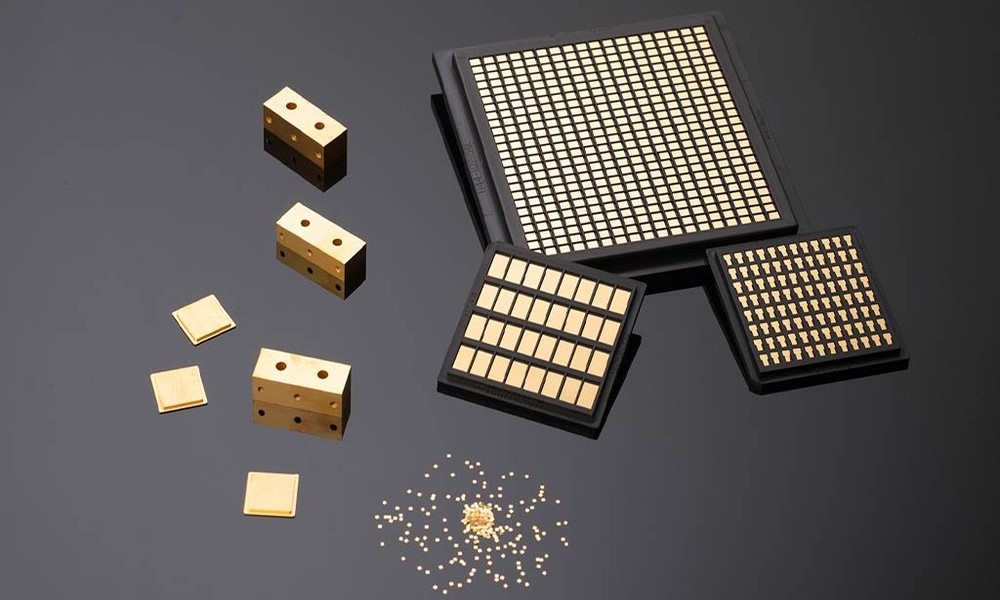
A tungsten heat sink dissipates thermal energy from high-power electronic and photonic devices more effectively than conventional aluminium or copper alternatives in applications where space constraints and thermal density converge. The material’s thermal conductivity, when alloyed with copper, reaches 200 W/mK while maintaining a coefficient of thermal expansion (CTE) closely matched to semiconductor substrates. This combination prevents the mechanical stress that causes solder joint failures and die cracking in power amplifiers, laser diodes, and RF modules operating under demanding thermal conditions.
Properties of Tungsten-Copper Composites
Pure tungsten conducts heat at 173 W/mK and expands at 4.5 ppm per degree Celsius. Pure copper conducts at 401 W/mK but expands at 16.5 ppm per degree Celsius. Tungsten-copper composites blend these properties in ratios tailored to specific applications. A W85Cu15 composition (85% tungsten, 15% copper by weight) delivers a CTE of 6.5 ppm per degree Celsius, closely matching gallium arsenide (5.9 ppm) and silicon carbide (4.0 ppm) substrates used in modern power electronics.
CTE Matching and Reliability
When a heat sink expands at a different rate than the semiconductor die bonded to it, cyclic thermal stress accumulates at the interface. After several thousand power cycles, this stress fractures solder joints or delaminates adhesive bonds. A tungsten heat sink with a CTE matched to within 1.5 ppm of the die substrate extends device lifetime from 10,000 cycles to over 100,000 cycles under identical operating conditions. Telecommunications base stations and satellite transponders depend on this longevity to avoid field replacements that cost thousands of dollars per unit.
Thermal Conductivity Versus Density Trade-offs
Tungsten-copper composites weigh between 15.5 and 17.0 g/cc, roughly twice the density of copper. In ground-based applications such as radar systems and industrial lasers, this weight penalty carries minimal consequence. Aerospace and satellite applications require careful mass budgeting, and engineers select the minimum tungsten content that satisfies CTE requirements to keep weight within allocation. AMT produces heat sinks in compositions ranging from W75Cu25 to W90Cu10, allowing customers to optimise the thermal conductivity and CTE balance for their specific thermal and mechanical constraints.
Manufacturing Processes
Tungsten-copper heat sinks begin as metal powder blends pressed into near-net-shape preforms. The pressed parts undergo sintering at temperatures between 1,100 and 1,300 degrees Celsius in hydrogen atmosphere furnaces. During sintering, copper melts and infiltrates the tungsten particle matrix through capillary action, creating a fully dense composite with porosity below 1%. Density verification by Archimedes method confirms that each sintered blank meets the target density before machining begins.
Precision Machining of Tungsten-Copper
Sintered blanks require finish machining to achieve the dimensional tolerances and surface finishes that semiconductor packaging demands. Tungsten-copper machines differently from conventional metals. The tungsten phase is abrasive and hard (Vickers hardness above 350), while the copper phase is soft and ductile. This disparity causes uneven tool wear and surface tearing if machining parameters are incorrect.
- Polycrystalline diamond (PCD) tooling required for finish cuts to achieve Ra values below 0.4 microns
- Cutting speeds held between 30 and 60 metres per minute to prevent copper smearing
- Coolant delivery through the spindle at pressures above 50 bar to flush tungsten particles from the cutting zone
- Surface flatness specifications of 2 microns or better across mounting faces up to 25 mm square
AMT’s machinists maintain separate tooling inventories for tungsten-copper work to prevent cross-contamination with other materials. Each cutting tool receives inspection after every 50 parts to verify edge condition and predict replacement timing before quality degrades.
Plating and Surface Finishing
Most tungsten-copper heat sinks receive nickel and gold plating to enable solder or epoxy bonding to semiconductor packages. The nickel barrier layer, typically 3 to 5 microns thick, prevents copper migration into the gold layer. Gold thickness ranges from 0.5 to 3.0 microns depending on the bonding method specified. AMT operates dedicated plating lines for tungsten copper thermal management components, with bath chemistry monitored hourly to maintain consistent plating thickness and adhesion across production batches.
“Singapore’s advanced manufacturing capabilities in refractory metals and composites support critical defence and telecommunications programmes globally,” said Professor Low Teck Seng, former Chief Executive of the National Research Foundation. “Companies with deep expertise in tungsten-copper processing occupy a niche that requires years of accumulated knowledge to enter.”
Applications Across Industries
Tungsten-copper heat sinks serve applications wherever high heat flux meets tight CTE matching requirements. RF power amplifiers in 5G base stations generate heat densities exceeding 150 watts per square centimetre at the transistor junction. Fibre laser pump modules concentrate thermal loads into areas smaller than 5 mm square. High-power LED arrays for industrial curing systems produce sustained thermal loads that aluminium substrates cannot manage without excessive temperature rise.
Military radar systems represent another significant application. Phased array antenna modules contain hundreds of individual transmit-receive elements, each requiring a CTE-matched heat spreader to maintain performance across operating temperature ranges spanning minus 40 to plus 85 degrees Celsius.
Quality Assurance and Testing
AMT inspects every tungsten heat sink using coordinate measuring machines for dimensional verification and scanning acoustic microscopy to detect internal voids or delaminations. Thermal conductivity measurements on sample parts from each production lot confirm that material properties meet specification. These protocols ensure that each tungsten heat sink performs reliably across the full operating envelope its application demands.