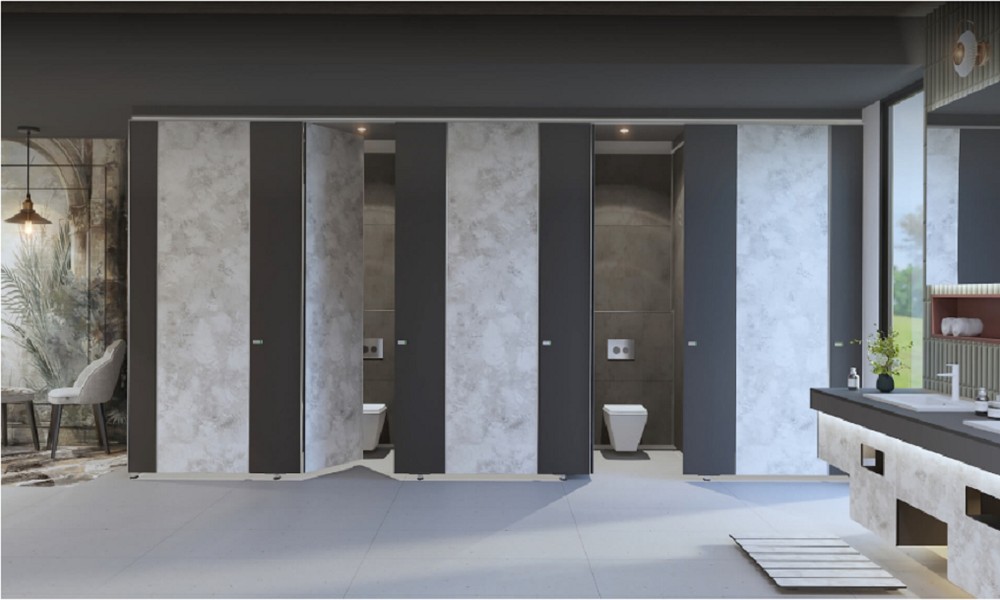
High-traffic commercial restroom partition specifications for airports, transit stations, sports venues, and university facilities require a more rigorous evaluation framework than the generic selections that suffice for standard office applications. Standard specifications applied to high-traffic contexts reveal their inadequacies within the first 2 to 3 years of installation.
What Are the Usage Cycle Limits of Standard Commercial Partition Products?
Partition manufacturer performance ratings are based on standard commercial usage assumptions of 100 to 200 daily users per toilet position. Airport and transit hub restrooms routinely exceed this by a factor of 3 to 5.
For high-traffic projects, specifiers should request 2 types of cycle-count data from manufacturers rather than relying on standard product ratings:
- Cycle-count test data for the partition panels under projected daily usage loads
- Hardware cycle-count ratings specifically for hinge and latch components, which fail before panels in properly specified installations
Which Hardware Specifications Improve Performance in High-Traffic Restrooms?
Door hardware is the most frequent failure point in commercial restroom partition systems under high-traffic conditions. 2 hardware specifications distinguish high-traffic from standard commercial applications:
- Continuous piano hinges: distribute door-open load across the full door height rather than concentrating it at 2 or 3 mounting points, producing significantly longer service life under thousands of daily door cycles
- Heavy-duty strike plates rated for the projected impact frequency: standard strike plates deform within the first 12 to 18 months in airport and transit applications
Specifiers selecting commercial restroom partitions for high-traffic projects should specify piano hinges in lieu of standard butterfly hinges, at a cost premium that is recovered in reduced hardware replacement frequency within the first 3 years of operation.
What Chemical Resistance Data Is Required for Intensified Cleaning?
High-traffic public restrooms undergo more frequent and more aggressive cleaning than standard commercial applications. Specifiers should require 2 documents from manufacturers before approving value engineering substitutions:
- Chemical compatibility documentation for the specific disinfectants in the facility’s janitorial program
- Finish durability test data showing surface integrity after 500 or more cleaning cycles at commercial disinfectant concentrations
What Structural Review Is Required for High-Traffic Anchorage?
High-traffic partition installations experience greater cumulative lateral loading than standard commercial specifications account for. 2 anchorage elements require structural review for installations in facilities with thousands of daily users:
- Pilaster floor brackets: must be verified against the floor slab capacity at each mounting location
- Overhead head rail wall anchors: must be verified against the wall structural capacity at the partition run end points.