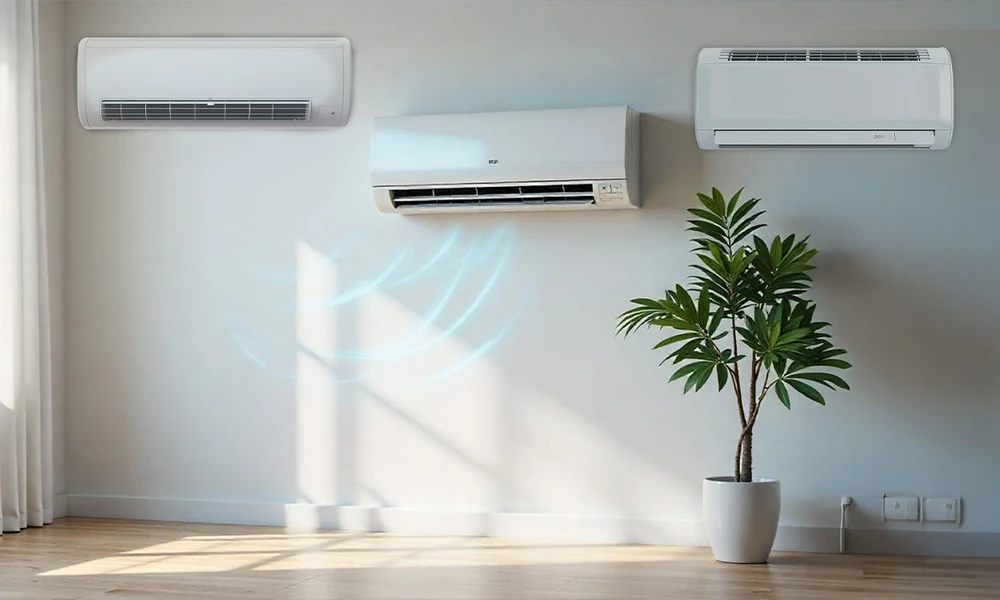
People commonly believe that you have to buy two different types of units – a very expensive and very quiet air conditioner and a highly-efficient AC with high SEER2 numbers – to get both effects. But in reality, the key to getting both results lies in proper sizing.
Sizing plays an important role for both these features, where the right-sized inverter air conditioning system helps in solving both these issues in an effective manner. It is important to choose the right split system air conditioner based on the footage.
Why Oversizing Ruins Both Goals
A too-large system cools fast, shuts off, then restarts minutes later. Each restart pulls a compressor surge – the loud “clunk” owners describe on HVAC forums – and burns more power than one steady cycle would. ACCA’s Manual J calculation prevents this by sizing capacity to actual heat gain, not square footage.
The 2026 SEER2 And Refrigerant Shift
Every newly installed split air conditioner sold in the United States is required to have regional SEER2 minimums. There is an equally important change that does not get nearly enough attention – the discontinuation of R-410A products in 2025. The new products use either R-32 or R-454B refrigerants, which have much less global warming potential.
| Region | Minimum SEER2 (2026) | Standard Refrigerant |
|---|---|---|
| North | 13.4 | R-32 / R-454B |
| Southeast | 14.3 | R-32 / R-454B |
| Southwest | 14.3 | R-32 / R-454B |
One point most buying guides miss: the federal 25C tax credit expired December 31, 2025 – budget the full installed cost, not a rebate.
Inverter Compressors Close The Trade-off
Inverter compressors ramp output up and down instead of switching fully on or off – this is what connects quiet and efficient operation. Indoor units run 25-35 decibels, close to a library; outdoor condensers run 48-60, versus 50-80 for ducted central systems fighting duct losses. That narrower range keeps the compressor in its efficiency sweet spot longer. Look for ENERGY STAR-certified models.
Sizing Your System Correctly
The best way to start is by having a contractor who is licensed do a Manual J calculation, not one based on BTU per square foot:
- Individual room heating loads, not an overall house figure
- Insulation, windows, and sun exposure factored in
- Ductless zoning for additions or unusually hot rooms
Getting this right before buying, not after installing an oversized split system air conditioner, separates a quiet, efficient home from a noisy, expensive one.
FAQs
How many decibels is a quiet split air conditioner?
Around 25-35 decibels indoors and under 55 outdoors count as quiet – comparable to a library or soft rainfall.
Do split ACs work well in extreme heat?
Yes. Inverters operate by maintaining capacity through adjusting the speed of the compressor, which is not possible with the traditional fixed-speed models that have trouble dealing with peak temperatures.
How long do split air conditioners last?
With proper maintenance, they can last 12 to 15 years, although replacement parts for the older R-410A may become harder to find.
Is a bigger split system air conditioner always better?
No. Oversizing causes short-cycling, raising noise and energy use – a proper load calculation beats buying extra capacity.
Can I install an air conditioner myself?
DIY-rated kits exist, but refrigerant connections and wiring still require licensed handling under most local codes.
The Key to Long-Term Comfort
Quiet and efficient were never separate features to shop for – they’re the same outcome, produced by the same decision: getting size and refrigerant right before the unit gets bolted to a wall. The homeowners happiest with their systems years later aren’t the ones who paid for the highest number on a spec sheet. They’re the ones whose contractor ran the numbers first – a short conversation that decides whether you forget the system is running or keep noticing it for the wrong reasons.