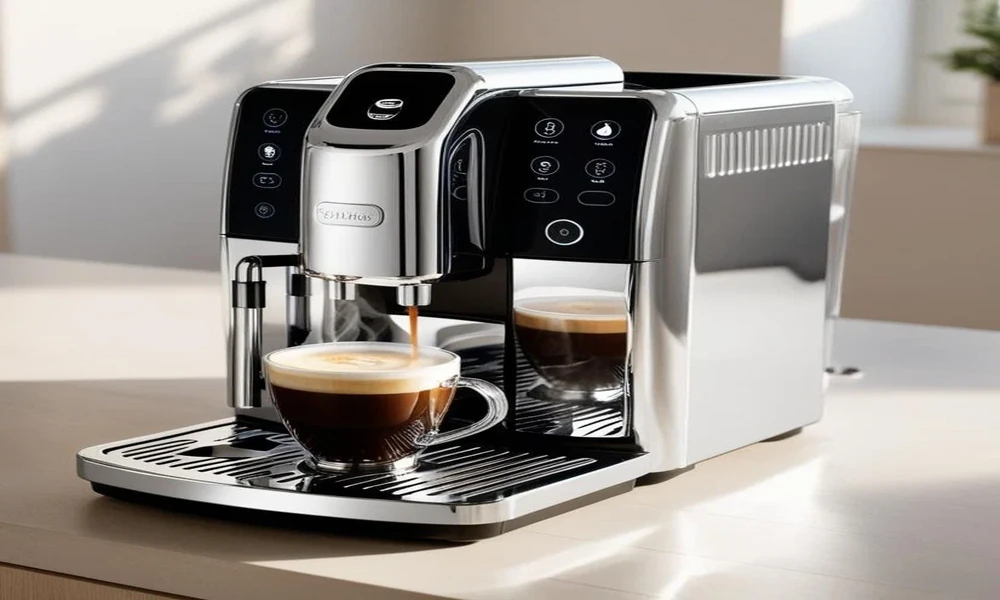
The most common mistake in office coffee is buying for the wrong number of people. A capsule machine bought for a team of eight is still there when the team is fifty, producing a queue every morning and a bin full of pods. A commercial bean-to-cup machine bought for a team of eight is an expensive counter ornament. Choosing a coffee machine for office use is mostly an exercise in matching equipment class to headcount.
Work Out Your Actual Cup Volume
Start with a number. A reasonable planning figure is one and a half to two drinks per person per day in a typical office, though this rises in workplaces with long hours and falls where much of the team is out visiting clients. More important than the daily total is the concentration, most of that volume lands between eight thirty and ten thirty, and again briefly after lunch. Specify against the morning peak, because that is when a machine either copes or generates complaints.
Up to Fifteen People
At this scale a capsule machine or a compact domestic bean-to-cup unit is usually adequate. Volume is low enough that cost per cup, while high with capsules, does not amount to much across a month, and simplicity is worth a great deal when nobody is responsible for maintaining equipment. A filter brewer alongside it handles the people who want a mug rather than an espresso drink, at very low cost.
Fifteen to Fifty People
This is where domestic equipment stops coping and offices most often under-buy. A light commercial bean-to-cup machine with a fresh milk system, ideally plumbed, handles this range comfortably. The key specification is recovery time between drinks rather than headline hourly capacity, since the test is six people queuing at nine. A machine at this class also brings automated rinse and cleaning cycles, which is what makes daily upkeep realistic without assigning someone to it.
Fifty to a Hundred and Fifty People
Genuine commercial equipment becomes necessary, larger boilers, faster recovery, higher-capacity grinders and hoppers, and construction built for continuous duty. Consider two machines rather than one, positioned in different areas, which halves the queue, provides redundancy when one is being serviced and reduces the distance people walk. Plumbing and drainage are effectively mandatory at this volume, since tank filling becomes a full-time irritation.
Above a Hundred and Fifty
Larger workplaces are usually better served by several machines distributed across floors than by one large installation, both for queueing and because a single failure otherwise affects everyone. At this scale it is worth considering a mix, bean-to-cup machines for espresso-based drinks and a batch brewer for volume, since a meaningful share of any large office wants a plain black coffee quickly. Suppliers of office coffee solutions will usually propose a distributed arrangement.
Meeting Rooms and Client-Facing Areas
These have different requirements from a staff pantry. Volume is low and unpredictable, presentation matters, and the person operating the machine may be a receptionist with a guest waiting. A simple, quick, reliably good machine beats a sophisticated one here, and capsules are entirely defensible in a boardroom where four drinks are made twice a week. Keep the pantry machine and the client-facing machine as separate decisions.
Fresh Milk or Powder
Fresh milk produces better drinks and requires a fridge, daily line cleaning and someone taking responsibility for both. Powdered systems are considerably easier to maintain and produce a recognisably different drink that some people dislike. The honest question is not which is better but who will clean the milk system every day. In an office where the answer is nobody, a powdered system that stays hygienic beats a fresh milk system that does not.
Hybrid Working Changes the Arithmetic
Offices operating on a hybrid pattern have a peculiar demand curve: near-empty on Mondays and Fridays, close to full capacity on Tuesdays and Wednesdays. Sizing to the average produces a machine that queues badly on the busy days, and sizing to peak means expensive equipment idle for much of the week. The workable answers are either to size for the busy days and accept the idle capacity, since a machine costs the same whether or not it runs, or to run a smaller permanent machine alongside a batch brewer that only comes out on full days. Count the busiest day rather than the headcount on the payroll.
Placement and Practicalities
A machine needs counter space, height clearance to open the hopper and bean container, ventilation behind, and ideally a sink and bin within a step. Grinder noise carries, so a machine directly beside open-plan desks will irritate people daily. Where the pantry has no drain, plumbing options narrow considerably. Walking the space with these constraints before choosing avoids the common outcome of a machine that fits the budget and not the pantry.
Rental Against Purchase
For most offices, renting bundles the machine with servicing, breakdown response and often the beans, and converts capital into a predictable monthly cost. Purchase suits organisations with facilities capability and stable requirements. Whichever route, compare on total monthly cost including consumables, and ask what happens when the machine stops. Sized against genuine peak demand rather than headcount alone, a coffee machine for office use becomes something nobody has to think about, which is the correct outcome.